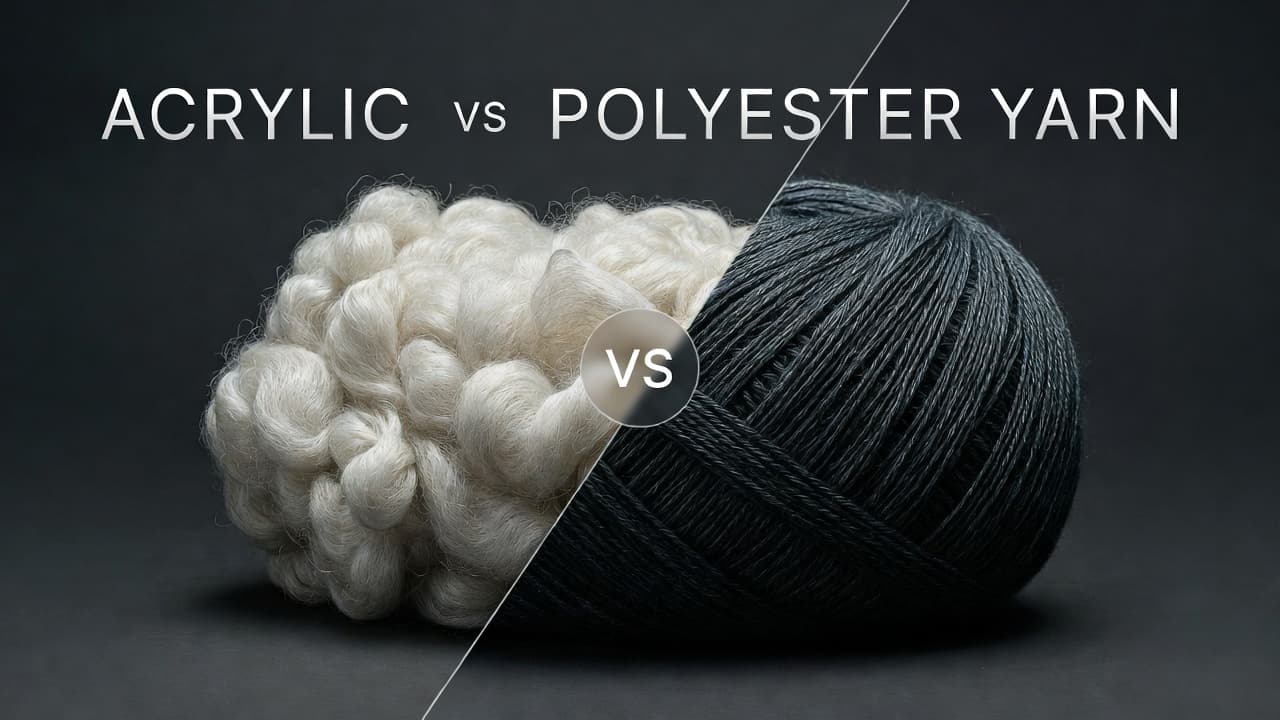

Acryl und Polyester sind beides synthetische Garne, aber sie glänzen in unterschiedlichen Bereichen: Polyester führt bei Festigkeit und Abriebfestigkeit; Acryl bei Lichtechtheit und Wärme (ca. 15 % wärmer als Wolle). Was «besser» ist, hängt von der benötigten Leistung ab — Haltbarkeit und Planheit nach dem Waschen sprechen für Polyester; Weichheit, Wärme und Sonnenbeständigkeit für Acryl.
Dieser Leitfaden vergleicht Acryl vs Polyestergarn und schlägt vor, wann man welches wählt.
Polyestergarn ist Garn aus Polyesterfaser (synthetisches Polymer). Polyester ist stark, abriebfest, elastisch und behält die Form nach wiederholtem Waschen. Es wird breit in Bekleidung, Heimtextilien und industriellen Anwendungen verwendet (z. B. Tischdecken, technische Stoffe).
Acrylgarn ist Garn aus Polyacrylnitril (Acryl) Faser. Acryl wird oft «synthetische Wolle» genannt: es ist voluminös, gekräuselt, weich und ca. 15 % wärmer als Wolle. Festigkeit 22,1–48,5 cN/dtex — 1–2,5× Wolle. Lichtechtheit ist die beste unter gängigen Synthetik; nach einem Jahr in der Sonne für Vorhänge, Planen und Markisen. Beständig gegen Säure, Oxidationsmittel und viele organische Lösungsmittel, aber schlechte Alkalibeständigkeit. Erweichungstemperatur ca. 190–230 °C.
| Eigenschaft | Polyester | Acryl |
|---|---|---|
| Festigkeit | Höchste der beiden; 2,6–8,0 cN/dtex | 22,1–48,5 cN/dtex; 1–2,5× Wolle |
| Abriebfestigkeit | Beste (nach Nylon) | Gut |
| Elastizität | Nahe Wolle; Rückstellung bei 5–6 % | Gut; ~65 % Resilienz bei 20 % Dehnung |
| Wärme | Mäßig | ~15 % wärmer als Wolle |
| Lichtechtheit | Gut (zweite nach Acryl) | Beste unter Synthetik |
| Form nach Waschen | Bleibt flach | Gut |
| Preis (typisch) | Oft niedriger | Oft höher |
| Haptik | Glatt, flach | Weich, fluffig, wollähnlich |
Zusammenfassung: Wählen Sie Polyester, wenn Festigkeit, Abriebfestigkeit und Planheit nach dem Waschen wichtig sind (z. B. Tischwäsche, Arbeitskleidung, technischer Einsatz). Wählen Sie Acryl, wenn Wärme, Weichheit, Lichtechtheit und wollähnliche Haptik wichtig sind (z. B. Pullover, Decken, Vorhänge).
Polyester glänzt bei Festigkeit, Abriebfestigkeit und Dimensionsstabilität (bleibt flach); Acryl bei Lichtechtheit, Wärme und wollähnlicher Weichheit. Es gibt kein einziges «besser» — wählen Sie nach Projekt: Haltbarkeit und Planheit → Polyester; Wärme, Weichheit und Sonnenbeständigkeit → Acryl.
Polyester ist allgemein stärker (höhere cN/dtex) und hat bessere Abriebfestigkeit als Acryl. Acryl ist stärker als Wolle, aber nicht als Polyester.
Acryl hat die beste Lichtechtheit unter gängigen Synthesefasern. Polyester ist gut, aber zweite nach Acryl; beide werden für Vorhänge und Outdoor-Textilien verwendet.
Acryl-Rohstoff und -Verarbeitung (Polymerisation, Spinnen, Kräuseln usw.) kosten oft mehr als Polyester. Acryl wird für wollähnliche Wärme und Weichheit bepreist; Polyester für Festigkeit und Vielseitigkeit.
Dieser Artikel ist Teil unserer Garnwissensserie mit praktischen Einblicken in synthetische Garntypen und Auswahl für Stricker und Stoffkäufer.