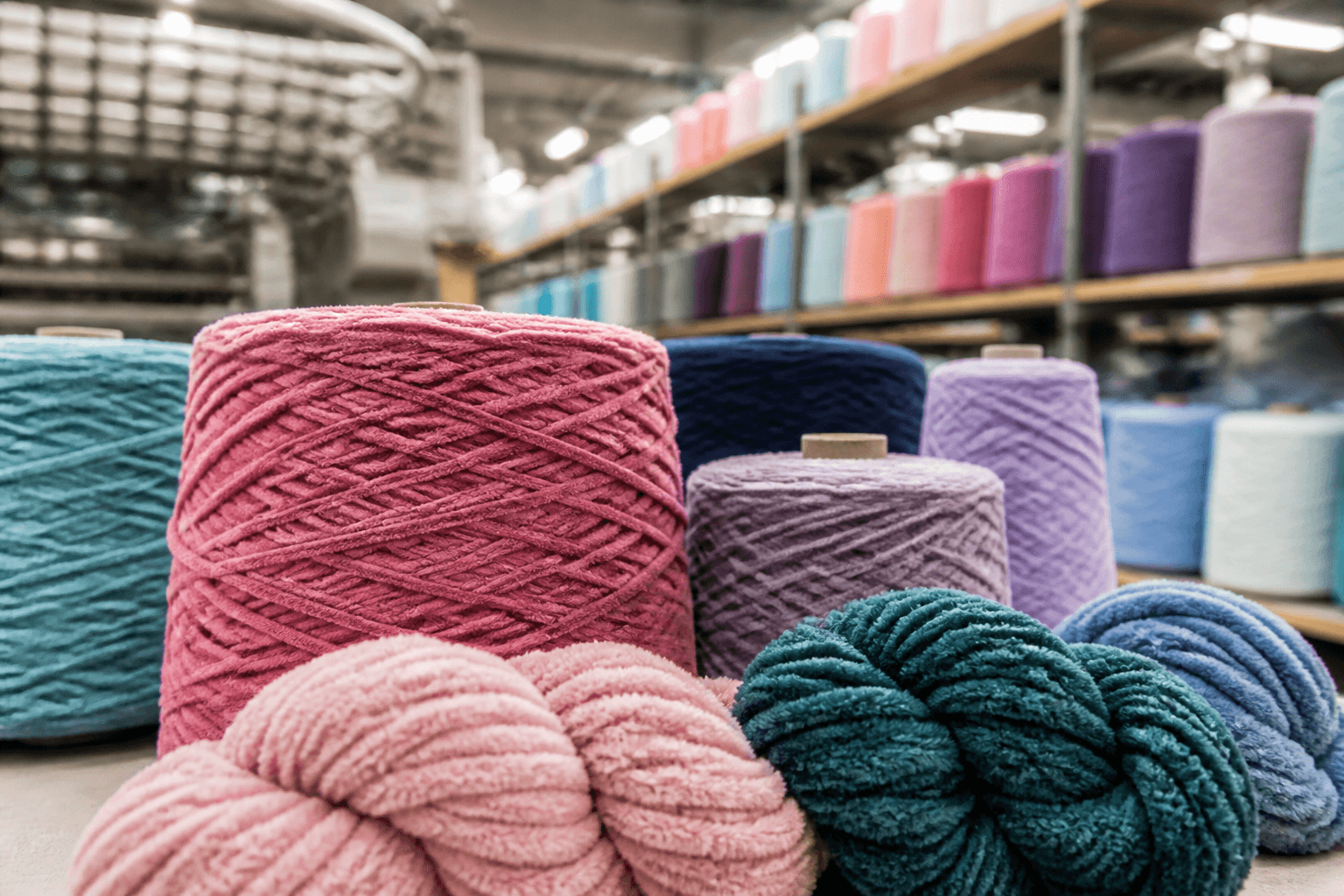

Chenille yarn is a fancy construction—pile, loft, and dye behavior vary a lot between lots. That makes who produces it more important than for many commodity acrylics. A manufacturer or mill-backed supplier can usually explain process, control shade, and repeat a program; a trading-only seller may offer flexible small lots but weaker visibility when quality drifts.
This guide helps importers, wholesalers, and private-label buyers spot the difference and decide when factory-backed supply is worth it. Product literacy: What Is Chenille Yarn? and What Is Chenille Yarn Used For?. Sourcing workflow: How to Source Yarn from China.
| Risk | Why chenille is sensitive |
|---|---|
| Shade variation | Pile and dye uptake show lot differences clearly |
| Shedding / durability | Construction and fiber quality show in use |
| Weight / yardage claims | Loft makes “same looking” balls unequal |
| Reorders | Hard to match without retained standards |
| OEM / private label | Needs process ownership, not spot buying |
If your business needs repeatable blankets, garments, or retail balls, prioritize suppliers who can own the production story.
| Signal | Manufacturer / mill-backed | Trading-only (typical) |
|---|---|---|
| Process answers | Can discuss route, count, dye, winding | Vague “factory partners” |
| Samples | Tied to a style no. and retained standard | Random stock balls |
| MOQ logic | Explained by dye / line economics | Whatever they can find this month |
| Site evidence | Mill photos, audit docs, stable entity | Changing workshop photos |
| Problem response | Adjust process / re-dye plan | Swap to another unknown source |
| OEM / private label | Structured development | Relabel if lucky |
“Factory-backed” can include long-term manufacturing partners with QC and export coordination—not only a single owned spinning hall. What matters is accountability for the lot you receive. See how we position supply on yarn manufacturer and OEM yarn manufacturer.
| Red flag | Risk |
|---|---|
| Price far below market with “any MOQ” | Likely spot goods / quality lottery |
| Cannot name fiber % precisely | Label and performance problems |
| Refuses retained sample / dip process | Reorder mismatch |
| Different factory story every call | No process ownership |
| Pushes full container before sample approval | Inventory trap |
| Certificates that do not match the product | Compliance failure |
Trading channels can work for:
They are a poor fit for branded lines, Amazon replenishment, or private label where customers expect the second order to match the first.
Use this as a scorecard (manufacturer-leaning answers should dominate for program business):
Full supplier vetting sits inside the wider China yarn sourcing guide.
Not always—but extremely flexible MOQ with vague process answers usually means spot inventory, not a controlled program. Ask how reorders are matched.
Some can broker introductions; you still need a party accountable for standards and QC. Prefer a documented OEM path (OEM process).
End use (e.g. blanket), fiber target, weight class, color count, pack format, kilos per color, destination—and whether private label is required. Use Get Free Quote.
Start with the yarn catalog and filter by your target construction, then confirm specs on the product page.
For chenille, process visibility beats a slightly lower FOB. Choose manufacturer or mill-backed partners when you need matching reorders, OEM, or retail packaging; use traders only when you consciously accept one-off risk.
Next steps: shortlist styles, request samples with written specs, and start a factory-backed inquiry—or review OEM and bulk program pages.
Sullivans International is a factory-backed yarn supplier for knitting and crochet programs, including chenille and fancy yarns for global B2B buyers. Get a free quote · OEM yarn manufacturer · Browse yarn catalog.