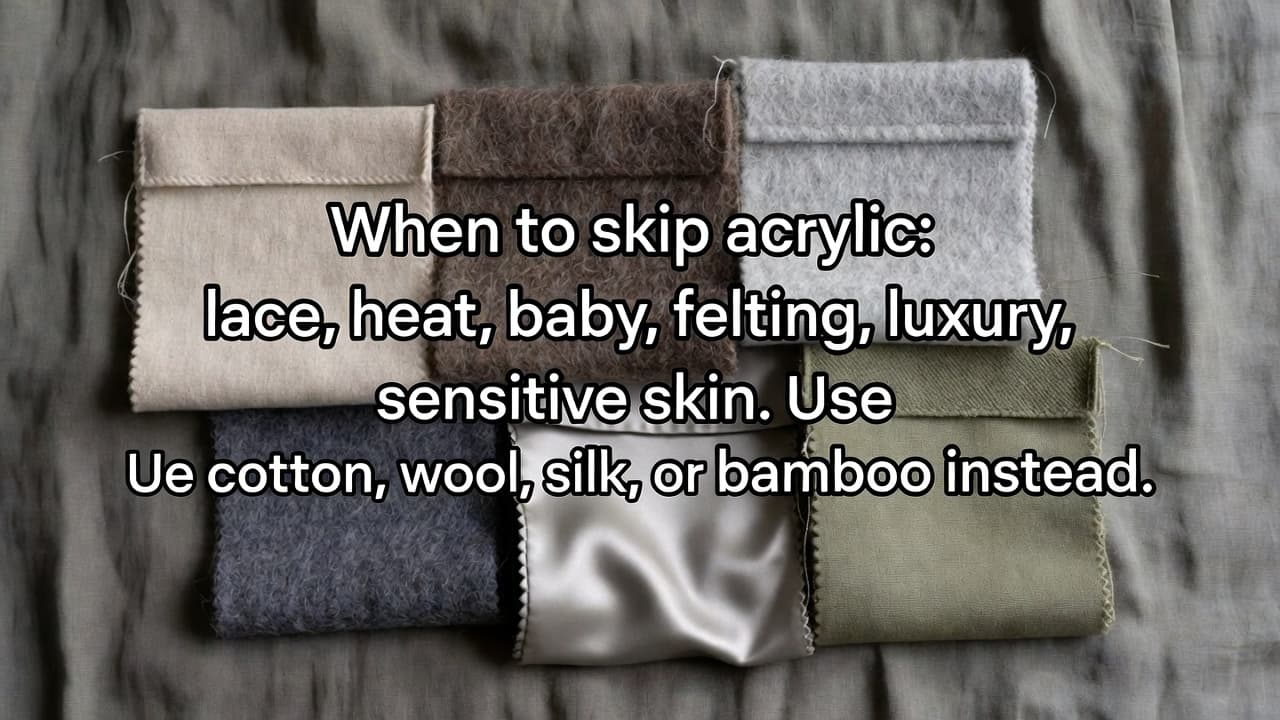

Akrylgarn är prisvärt, mångsidigt och lättskött, vilket gör det till ett vanligt val för stickare och virkare. Det finns ändå situationer då det är bättre att inte använda akryl: spets, hög värme, babyartiklar, tovning, high-end-projekt och känslig hud. I dessa fall är bomull, ull, silke, bambu eller merino ofta bättre.
Denna guide förklarar när du inte bör använda akrylgarn och vad du ska använda i stället.
Akrylgarn är garn av syntetisk (plast) fiber. Det är mjukt, färgbeständigt, maskintvättbart och budgetvänligt. Det tovas inte, smälter vid hög värme och har ofta en fyllig, slät hand som inte är idealisk för mycket fin spets eller för tovning.
Varför: Akryl är ofta fylligt och tjockt och saknar den fina, skarpa definitionen och naturliga glansen som många spetsmönster behöver.
Använd i stället: Bomull, silke, ull eller blandningar som är finare och slätare för delikat spets.
Varför: Akryl är syntetiskt och kan smälta eller deformeras vid hög värme (t.ex. varm spis, torktumlare, direkt värme).
Använd i stället: Bomull, ull, bambu eller andra naturfibrer som tål värme bättre för föremål nära värmekällor (t.ex. kök, varma miljöer).
Varför: Vissa bebisar kan få allergier eller hudirritation av akryl. Av säkerhets- och komfortskäl föredras naturfibrer ofta mot huden.
Använd i stället: Bomull, bambu eller merinoull (mjuk, andningsbar, skonsam).
Varför: Akryl tovas inte; tovning kräver djurfibrer (t.ex. ull, alpakka) som filtar och krymper med värme och gnidning.
Använd i stället: Ull eller alpakka (och andra tovningsbara djurfibrer).
Varför: Akryl har oftast en mindre lyxig hand och lägre hållbarhet än premium naturfibrer för tröjor, sjal och halsdukar som ska se ut och hålla som lyxstycken.
Använd i stället: Ull, kaschmir, silke eller blandningar av dessa för high-end utseende och känsla.
Varför: Akryl kan kännas klående eller obekvämt för vissa, särskilt med känslig hud.
Använd i stället: Bomull, bambu, merino, silke eller alpakka för skonsammare hudkontakt.
| Situation | Föredra i stället |
|---|---|
| Spets | Bomull, silke, ull (finare, bättre definition) |
| Hög värme | Bomull, ull, bambu |
| Babykläder | Bomull, bambu, merino |
| Tovning | Ull, alpakka |
| Lyxigt utseende/känsla | Ull, kaschmir, silke |
| Känslig hud | Bomull, bambu, merino, silke, alpakka |
Akrylgarn är utmärkt för många projekt, men undvik det för spets, hög värme, babyartiklar, tovning, high-end-stycken och känslig hud. Att välja bomull, ull, silke, bambu eller merino i dessa fall förbättrar resultat, komfort och säkerhet.
Det är möjligt, men bomull, bambu eller merino är ofta säkrare och skonsammare för bebisar; vissa spädbarn reagerar på akryl.
Tovning kräver djurfibrer med fjäll som låser ihop med värme och gnidning. Akryl är slät syntetisk och tovas inte.
Det kan klå eller irritera vissa. Naturfibrer (bomull, merino, bambu, silke) är vanligtvis bättre för känslig hud.
Denna artikel är en del av vår garnkunskapsserie med praktiska råd om när stickare och virkare bör välja akryl framför andra fibrer.