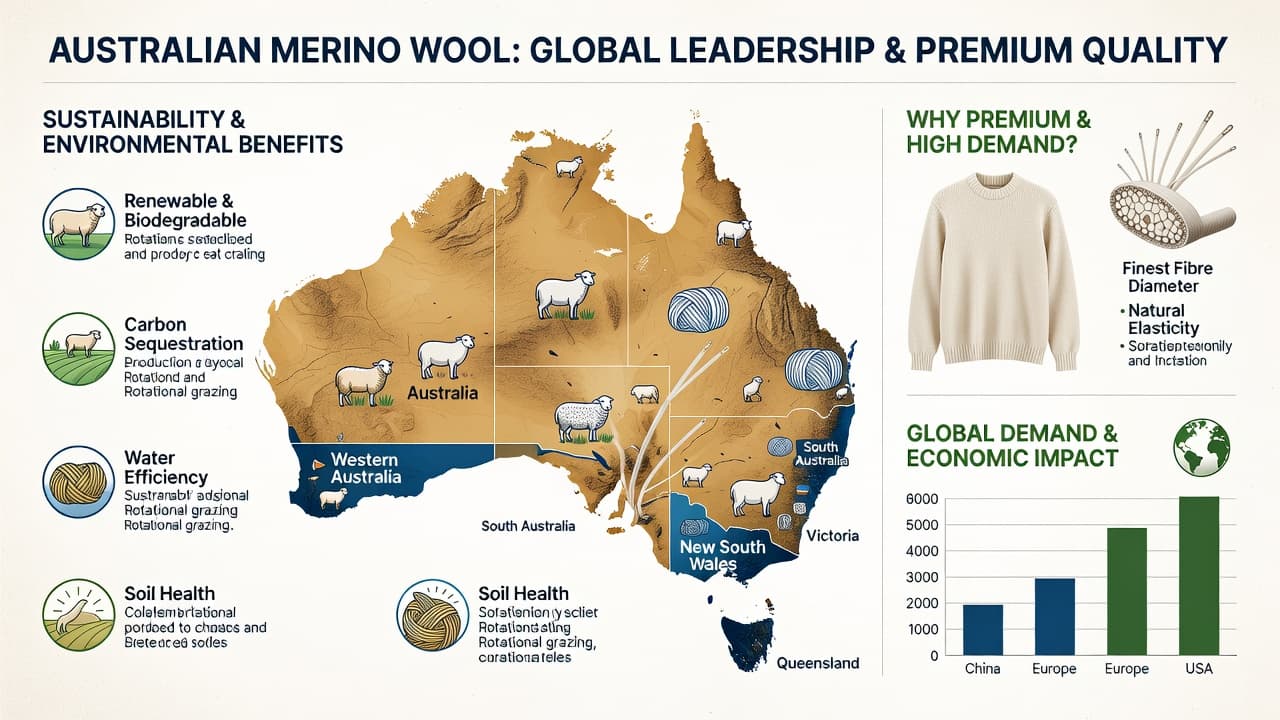
Australien är världens största producent av merinoull och står för cirka 80 % av den globala merinoullproduktionen. Australisk merino är känd för fin, mjuk fiber, andningsbarhet, värme och fukttransport, och industrin betonar hållbarhet, djurskydd och etiska metoder. Merinofår fördes till Australien från Spanien i slutet av 1700-talet och har blivit en viktig del av den australiska ekonomin.
I den här guiden förklarar vi varför Australien leder, de viktigaste produktionsregionerna och vad som gör australisk merino premium.
Australien. Australien producerar merinoull av hög kvalitet och står för cirka 80 % av den totala merinoullen som produceras globalt. Inget annat land kommer i närheten i volym specifikt för merino.
Merinoull produceras i flera regioner i Australien, inklusive:
Dessa regioner erbjuder varierade landskap och klimat som passar merinofår och ullproduktion.
Faktorer som stödjer Australiens ledning inkluderar:
Den australiska merinoindustrin fokuserar också på hållbarhet, djurskydd och etiska metoder, så att ull produceras på ett miljömässigt ansvarsfullt och humant sätt.
Australisk merinoull är mångsidig, hållbar och premium. Den används i:
Efterfrågan drivs av medvetenhet om naturfibrer och hållbar produktion.
Australien är världens största producent av merinoull, med cirka 80 % av global merinoproduktion. Australisk merino är premium, mångsidig och eftertraktad världen över, med fokus på hållbarhet och djurskydd. När du köper merino kommer den ofta från eller är blandad med australisk ull.
Australien producerar mest merinoull, med cirka 80 % av global merinoproduktion.
Merinofår introducerades i Australien från Spanien i slutet av 1700-talet och har varit centrala för australisk ullproduktion sedan dess.
Australisk merino värderas för fin kvalitet, stark genetik, avancerat jordbruk, fokus på hållbarhet och djurskydd, och en pålitlig försörjningskedja som levererar premium fiber globalt.
Den här artikeln ingår i vår garnkunskapsserie med praktiska insikter om merinoullproduktion och -inköp.