Akrylgarn är ett populärt, budgetvänligt val för stickning och virkning, men har flera nackdelar som spelar roll för komfort, hållbarhet och hållbar utveckling. Att förstå dessa minus hjälper dig avgöra när akryl passar och när du bör välja ull, bomull eller blandningar.
I den här guiden täcker vi sju viktiga nackdelar med akrylgarn och när du bör överväga alternativ.
Akrylgarn är en syntetisk fiber tillverkad av polymer (oljebaserade) material. Det är prisvärt, lättskött och finns i många färger. Till skillnad från naturfibrer transporterar inte akryl fukt bra och kan hålla kvar värme.
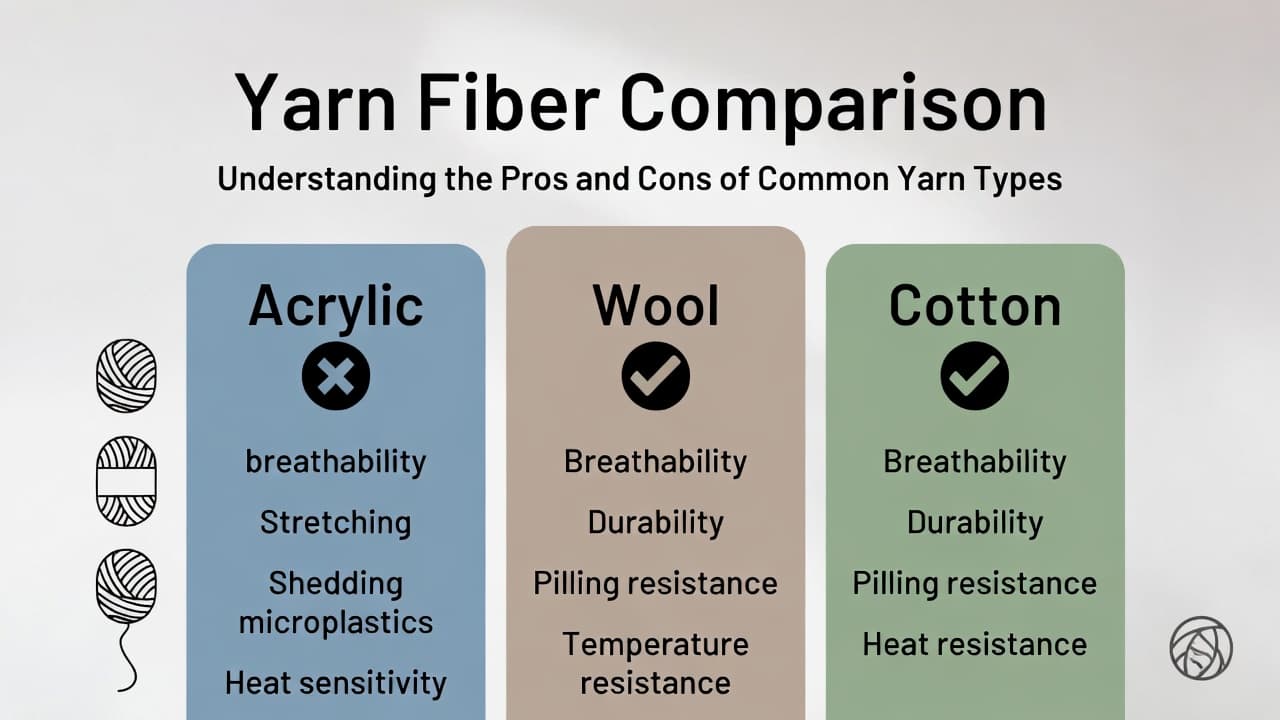
Akryl transporterar inte fukt som ull, bomull eller bambu. Det tenderar att hålla kvar värme och svett, så plagg känns klibbiga — särskilt för sockor, halsdukar eller vinterkläder. Ull hjälper reglera temperaturen genom att transportera bort fukt; akryl gör inte det.
Till skillnad från ull som studsar tillbaka har akrylgarn tendens att sträcka ut sig och hänga med användning. Detta påverkar:
Tips: För projekt som behöver elasticitet, överväg akryl-ull-blandningar eller superwash-ull.
Många hantverkare tycker akryl är styvt, plastigt eller grovt jämfört med merino eller kashmir. Premium-akryl kan vara mjukare, men budgetalternativ saknar ofta känslan av naturfibrer.
Akrylgarn noppa lättare än högkvalitetsull eller bomull. Friktion skapar små fiberkulor på ytan. För att minska nopping: handtvätta, förvara vikt (inte hängande), använd tyg rakapparat försiktigt.
Akryl är oljebaserat och:
Alternativ: Ekologisk bomull, bambu, återvunnet garn eller ull för lägre miljöpåverkan.
Till skillnad från ull (som kolbildar) eller bomull (som brinner långsamt) smälter akryl vid hög värme. Undvik för:
Säkrare val: Bomull eller ullblandningar för värmekänsliga föremål.
Akryl absorberar inte vatten bra och håller formen dåligt vid blockering. Ångblockering kan permanent platta maskor. Akryl fungerar bäst för projekt där blockering inte är avgörande (t.ex. amigurumi, enkla halsdukar, marknadspåsar).
| Behov | Akryl | Bättre alternativ |
|---|---|---|
| Budgetvänligt | ✓ | ✗ |
| Enkel maskintvätt | ✓ | Superwash-ull |
| Andningsförmåga | ✗ | Ull, bomull, bambu |
| Elasticitet | ✗ | Ull, ullblandningar |
| Värmebeständighet | ✗ | Bomull, ull |
| Hållbarhet | ✗ | Bomull, ull, återvunnet |
| Blockering | ✗ | Ull, bomull |
Akrylgarn erbjuder prisvärdhet och enkel skötsel, men har nackdelar i andningsförmåga, elasticitet, nopping, hållbarhet och värmebeständighet. För komfort, hållbarhet och miljövänlighet överväg ull, bomull eller blandningar. Välj utifrån ditt projekt, budget och värderingar.
Akryl är generellt säkert att bära. Vissa tycker det är mindre bekvämt på grund av dålig andningsförmåga. Akrylallergi är sällsynt; ullallergi är vanligare.
Ja. Akryl tenderar att noppa mer än högkvalitetsull eller bomull. Handtvätt och rätt förvaring kan minska nopping.
Akryl blockar dåligt. Ångblockering kan permanent platta maskor. Använd blockering bara när det behövs och med försiktighet.
Ull, bomull, bambu och blandningar ger bättre andningsförmåga, elasticitet och hållbarhet. Superwash-ull kan maskintvättas som akryl.
Den här artikeln är en del av vår garnkunskapsserie med praktiska insikter om fibertyper, skötsel och projektval för stickare och virkare.