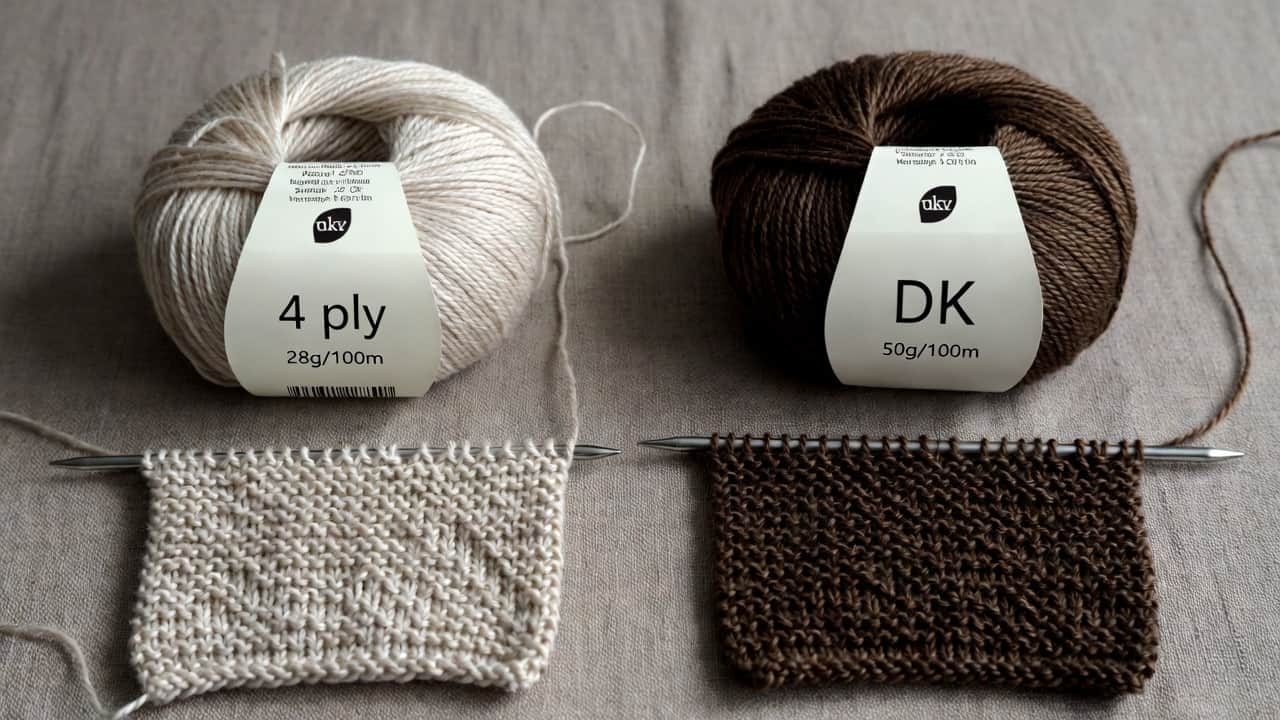

4 ply and DK (double knitting) are different yarn weights. 4 ply is thinner (about 28g per 100m); DK is thicker (about 50g per 100m). You can use 4 ply instead of DK if you match gauge by swatching and adjusting needle size—otherwise the finished size and fabric will change. Substitution depends on pattern and gauge, not a 1:1 swap.
In this guide, we explain 4 ply vs DK, how to substitute, and when it works.
So DK gives a thicker and looser result than 4 ply when using the same needle size and stitch count. Gauge (stitches and rows per inch) will differ if you swap one for the other without changing anything.
Yes, with adjustments. Substitution depends on gauge. If you use 4 ply in a pattern written for DK without changing needle size or stitch count, you will get smaller, denser fabric. To substitute safely:
If gauge is similar after adjustment, you can use 4 ply; if it is very different, stick to DK or change the pattern accordingly.
| Step | Action |
|---|---|
| 1 | Swatch with 4 ply and measure gauge. |
| 2 | Compare to pattern gauge. |
| 3 | If 4 ply gives more st/in (denser), try larger needles to loosen gauge. |
| 4 | If gauge still doesn’t match, use DK or adapt pattern (size, yardage). |
Yardage: Thinner yarn usually needs more length for the same size; check pattern yardage and buy enough 4 ply.
4 ply is thinner than DK (~28g vs ~50g per 100m). You can use 4 ply instead of DK by swatching, matching gauge (often with larger needles), and adjusting pattern or expectations. Always check gauge and yardage when substituting.
No. 4 ply is thinner (e.g. ~28g/100m); DK is thicker (~50g/100m). They are different yarn weights.
Swatch with 4 ply, measure gauge, and compare to the pattern. Adjust needle size (often go up) to get similar gauge, or change pattern size/yardage. Ensure you have enough 4 ply (often more meters than DK).
Yes, if you don’t adjust. 4 ply usually gives more stitches per inch (smaller, denser fabric). Change needle size or pattern to get the desired size.
This article is part of our yarn knowledge series, offering practical insights into yarn weights and substitution for knitters and crocheters.
