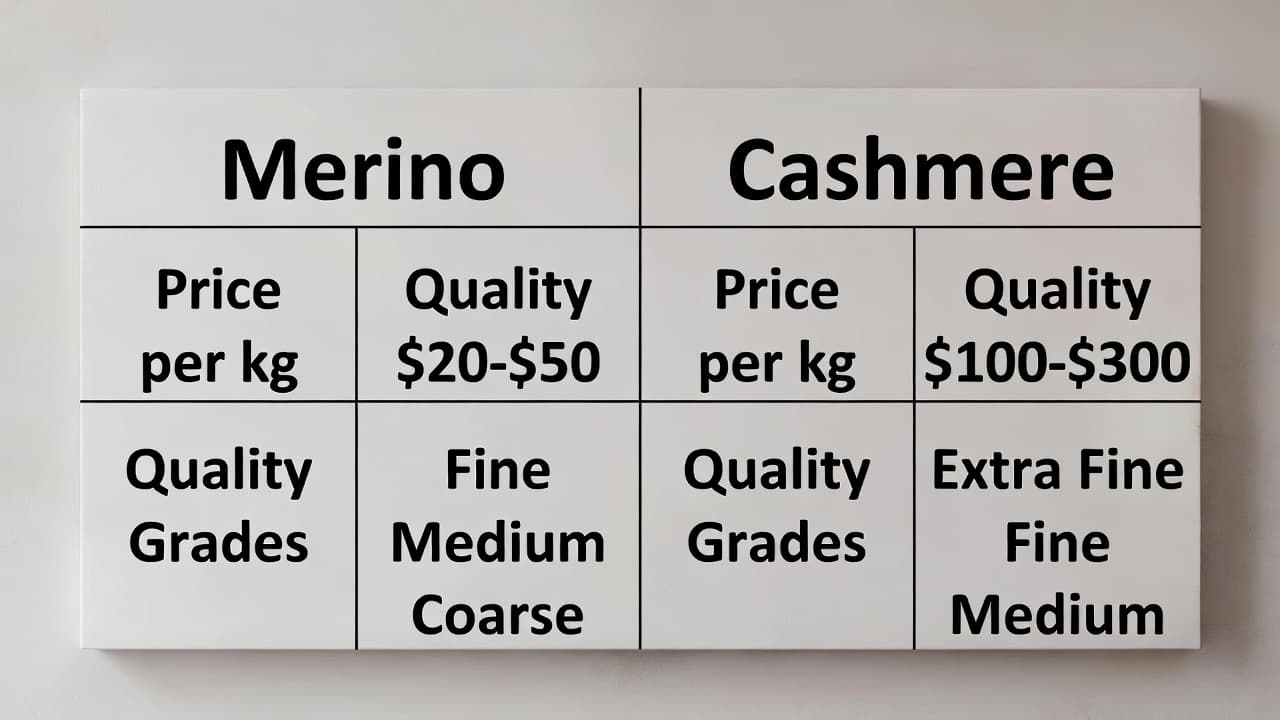

Kasjmir er generelt dyrere enn merinoull. Begge er premiumfibre, men kasjmir koster mer på grunn av begrenset tilbud, arbeidskrevende bearbeiding og luksusposisjonering. Merino tilbyr lignende mykhet og komfort til en lavere pris.
I denne guiden sammenligner vi prisfaktorer, kvalitetsgrader og verdi for merino vs kasjmir.
Merinoull kommer fra merinofår, hovedsakelig i Australia og New Zealand. Den er myk, lett og holdbar. Merino er et premiumstoff, men typisk mer rimelig enn kasjmir.
Kasjmir kommer fra mykt underull av kasjmiergeiter i Kina, Mongolia, Iran og Sentral-Asia. Fibrene er kortere og finere enn merino og krever mer bearbeiding. Kasjmir er sjeldnere og dyrere.
Kasjmiergeiter produserer mindre fiber per dyr enn merinofår. Begrenset tilbud driver prisene opp.
Kasjmirfibre er kortere og finere og krever mer tid og innsats å bearbeide. Dette øker produksjonskostnadene.
Kasjmir posisjoneres som luksus og brukes i high-end designertøy. Merker tar en premie for kasjmirplagg.
Begge fibre finnes i grader. Høyere grader (finere, mykere) koster mer. Topp kasjmir kan koste flere ganger merinoprisen.
| Aspekt | Merinoull | Kasjmir |
|---|---|---|
| Typisk pris | Lavere | Høyere |
| Tilbud | Mer rikelig | Mer begrenset |
| Bearbeiding | Mindre intensiv | Mer intensiv |
| Luksusposisjonering | Premium | Luksus |
| Verdi | Ofte bedre verdi | Premium-priser |
Kasjmir er dyrere enn merino på grunn av knapphet, bearbeiding og luksusposisjonering. Merino tilbyr utmerket mykhet og komfort til en lavere pris. Velg basert på budsjett og hvor mye du verdsetter den ekstra luksusen ved kasjmir.
Ja. Merino er typisk mer rimelig enn kasjmir. Begge er premium; kasjmir har en høyere pris.
Kasjmiergeiter produserer begrenset fiber, bearbeiding er arbeidskrevende, og kasjmir markedsføres som luksusfiber.
Høykvalitets merino kan nærme seg kasjmir i mykhet. Kasjmir er ofte finere og lettere, men forskjellen varierer etter grad.
Merino tilbyr ofte best verdi — myk, varm og holdbar til en lavere pris enn kasjmir.
Denne artikkelen er en del av vår ullkunnskapsserie med praktiske innsikter i luksusfiberpriser og -valg.