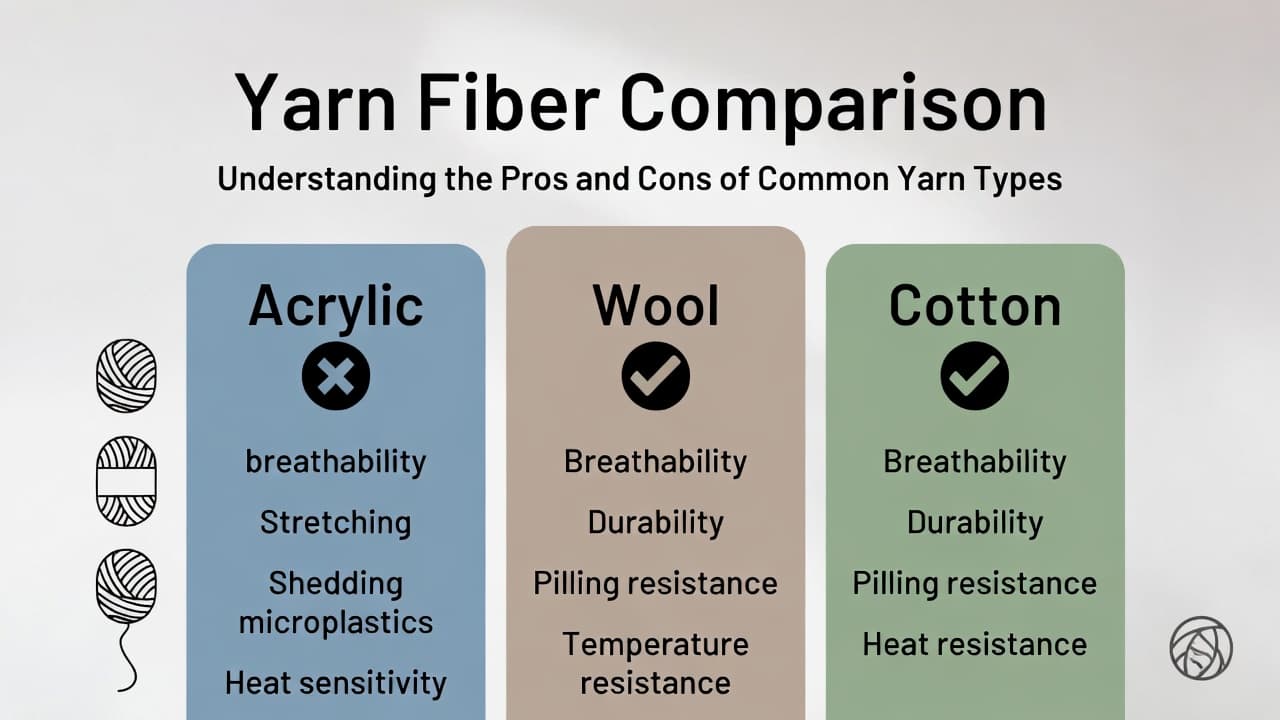

Acrylgaren is een populaire, budgetvriendelijke keuze voor breien en haken, maar heeft verschillende nadelen die belangrijk zijn voor comfort, duurzaamheid en milieu. Deze minpunten te begrijpen helpt bepalen wanneer acryl geschikt is en wanneer wol, katoen of blends beter zijn.
In deze gids behandelen we zeven belangrijke nadelen van acrylgaren en wanneer alternatieven te overwegen.
Acrylgaren is een synthetische vezel gemaakt van polymeer (op aardolie gebaseerde) materialen. Het is betaalbaar, onderhoudsvriendelijk en verkrijgbaar in veel kleuren. Anders dan natuurlijke vezels voert acryl vocht slecht af en kan het warmte vasthouden.
Acryl voert vocht niet af zoals wol, katoen of bamboe. Het houdt warmte en zweet vast, waardoor kleding klam aanvoelt — vooral bij sokken, sjaals of winterkleding. Wol helpt de temperatuur te reguleren door vocht af te voeren; acryl niet.
Anders dan wol, die terugveert, heeft acrylgaren de neiging om uit te rekken en door te zakken bij gebruik. Dit beïnvloedt:
Tip: Voor projecten die elasticiteit nodig hebben, overweeg acryl-wol blends of superwash wol.
Veel handwerkers vinden acryl stijf, plasticachtig of ruw vergeleken met merino of kasjmier. Premium acryl kan zachter zijn, maar budgetopties missen vaak het gevoel van natuurlijke vezels.
Acrylgaren pillt sneller dan hoogwaardige wol of katoen. Wrijving veroorzaakt kleine vezelbolletjes op het oppervlak. Pilling verminderen: handwassen, opgevouwen bewaren (niet hangen), stofscheermachine voorzichtig gebruiken.
Acryl is op aardolie gebaseerd en:
Alternatieven: Biologisch katoen, bamboe, gerecycled garen of wol voor lagere milieu-impact.
Anders dan wol (die verkoolt) of katoen (die langzaam brandt), smelt acryl bij hoge hitte. Vermijd voor:
Veiligere opties: Katoen of wol blends voor hittegevoelige items.
Acryl absorbeert water slecht en houdt de vorm slecht bij blocken. Stoomblocken kan steken permanent platdrukken. Acryl werkt het best voor projecten waarbij blocken niet cruciaal is (bijv. amigurumi, eenvoudige sjaals, markttassen).
| Behoefte | Acryl | Beter alternatief |
|---|---|---|
| Budgetvriendelijk | ✓ | ✗ |
| Gemakkelijk machinewasbaar | ✓ | Superwash wol |
| Ademend vermogen | ✗ | Wol, katoen, bamboe |
| Elasticiteit | ✗ | Wol, wol blends |
| Hittebestendigheid | ✗ | Katoen, wol |
| Duurzaamheid | ✗ | Katoen, wol, gerecycled |
| Blocken | ✗ | Wol, katoen |
Acrylgaren biedt betaalbaarheid en eenvoudige verzorging, maar heeft nadelen in ademend vermogen, elasticiteit, pilling, duurzaamheid en hittebestendigheid. Voor comfort, duurzaamheid en milieuvriendelijkheid overweeg wol, katoen of blends. Kies op basis van uw project, budget en waarden.
Acryl is over het algemeen veilig om te dragen. Sommigen vinden het minder comfortabel door slecht ademend vermogen. Acrylallergieën zijn zeldzaam; wolallergieën komen vaker voor.
Ja. Acryl neigt meer te pillen dan hoogwaardige wol of katoen. Handwassen en juiste opslag kunnen pilling helpen verminderen.
Acryl blokkeert slecht. Stoomblocken kan steken permanent platdrukken. Gebruik blocken alleen wanneer nodig en met zorg.
Wol, katoen, bamboe en blends bieden beter ademend vermogen, elasticiteit en duurzaamheid. Superwash wol is machinewasbaar zoals acryl.
Dit artikel maakt deel uit van onze garenkennisserie met praktische inzichten over vezeltypes, verzorging en projectkeuze voor breisters en haaksters.