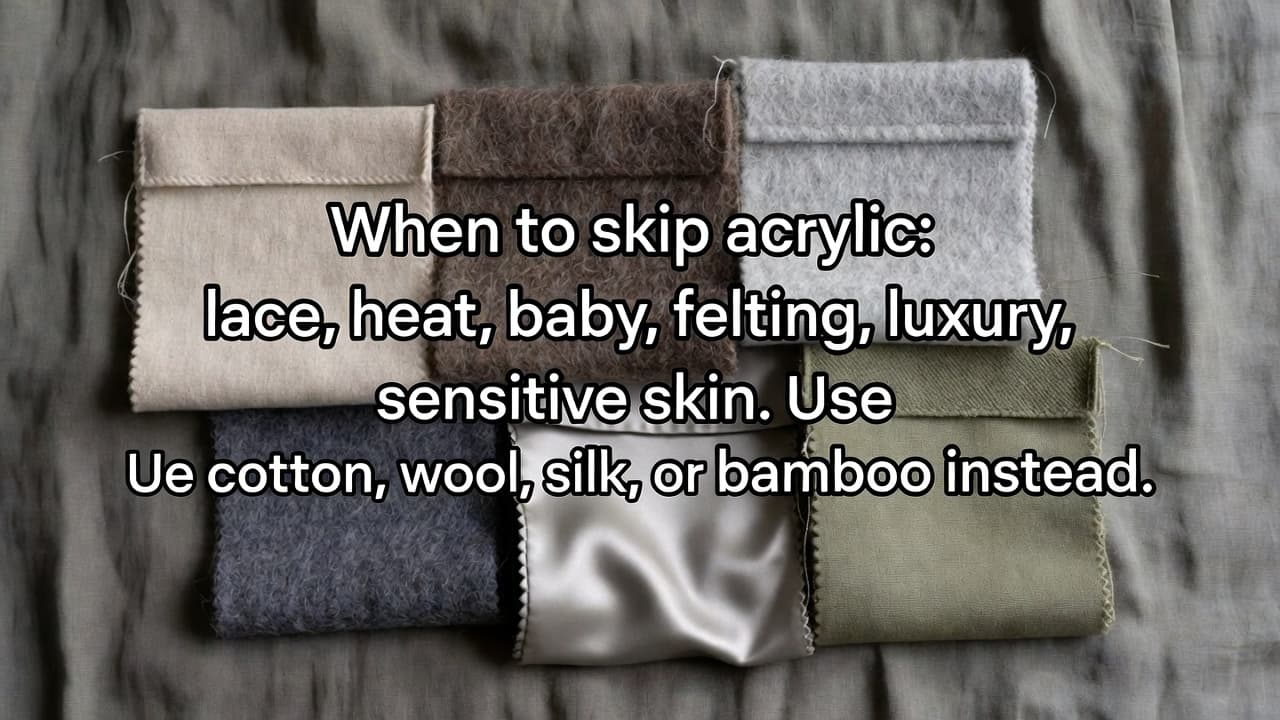

Le fil acrylique est abordable, polyvalent et facile d'entretien, ce qui en fait un choix courant pour tricoteurs et crocheteurs. Il existe toutefois des situations où il vaut mieux ne pas utiliser l'acrylique : dentelle, chaleur intense, articles bébé, feutrage, projets haut de gamme et peau sensible. Dans ces cas, coton, laine, soie, bambou ou mérinos sont souvent préférables.
Ce guide explique quand ne pas utiliser de fil acrylique et quoi utiliser à la place.
Le fil acrylique est un fil en fibre synthétique (plastique). Il est doux, solide en couleur, lavable en machine et économique. Il ne feutre pas, fond à haute température et a souvent une main volumineuse et lisse, peu adaptée à la dentelle très fine ou au feutrage.
Pourquoi : L'acrylique est souvent volumineux et épais et manque de la définition fine et nette et du lustre naturel requis par de nombreux motifs de dentelle.
Utiliser plutôt : Coton, soie, laine ou mélanges plus fins et lisses pour une dentelle délicate.
Pourquoi : L'acrylique est synthétique et peut fondre ou se déformer sous forte chaleur (p. ex. cuisinière chaude, sèche-linge, chaleur directe).
Utiliser plutôt : Coton, laine, bambou ou autres fibres naturelles mieux adaptées à la chaleur pour les articles près des sources de chaleur (p. ex. cuisine, environnements chauds).
Pourquoi : Certains bébés peuvent avoir des allergies ou une irritation cutanée avec l'acrylique. Pour la sécurité et le confort, les fibres naturelles sont souvent préférées au contact de la peau.
Utiliser plutôt : Coton, bambou ou laine mérinos (douce, respirante, douce pour la peau).
Pourquoi : L'acrylique ne feutre pas ; le feutrage nécessite des fibres animales (p. ex. laine, alpaga) qui s'emmêlent et rétrécissent avec chaleur et agitation.
Utiliser plutôt : Laine ou alpaga (et autres fibres animales feutrables).
Pourquoi : L'acrylique a généralement une main moins luxueuse et une durabilité moindre que les fibres naturelles premium pour pulls, châles et écharpes destinés à paraître et durer comme des pièces de luxe.
Utiliser plutôt : Laine, cachemire, soie ou mélanges de celles-ci pour un aspect et un toucher haut de gamme.
Pourquoi : L'acrylique peut gratter ou gêner certaines personnes, surtout celles à peau sensible.
Utiliser plutôt : Coton, bambou, mérinos, soie ou alpaga pour un port plus doux au contact de la peau.
| Situation | Préférer plutôt |
|---|---|
| Dentelle | Coton, soie, laine (plus fin, meilleure définition) |
| Chaleur intense | Coton, laine, bambou |
| Vêtements bébé | Coton, bambou, mérinos |
| Feutrage | Laine, alpaga |
| Aspect/toucher luxe | Laine, cachemire, soie |
| Peau sensible | Coton, bambou, mérinos, soie, alpaga |
Le fil acrylique convient à de nombreux projets, mais évitez-le pour la dentelle, la chaleur intense, les articles bébé, le feutrage, les pièces haut de gamme et la peau sensible. Choisir coton, laine, soie, bambou ou mérinos dans ces cas améliore le résultat, le confort et la sécurité.
C'est possible, mais coton, bambou ou mérinos sont souvent plus sûrs et plus doux pour les bébés ; certains nourrissons réagissent à l'acrylique.
Le feutrage nécessite des fibres animales avec des écailles qui s'accrochent avec chaleur et agitation. L'acrylique est synthétique lisse et ne feutre pas.
Il peut gratter ou irriter certaines personnes. Les fibres naturelles (coton, mérinos, bambou, soie) sont généralement meilleures pour la peau sensible.
Cet article fait partie de notre série sur les fils, avec des conseils pratiques sur quand choisir l'acrylique plutôt que d'autres fibres pour tricoteurs et crocheteurs.