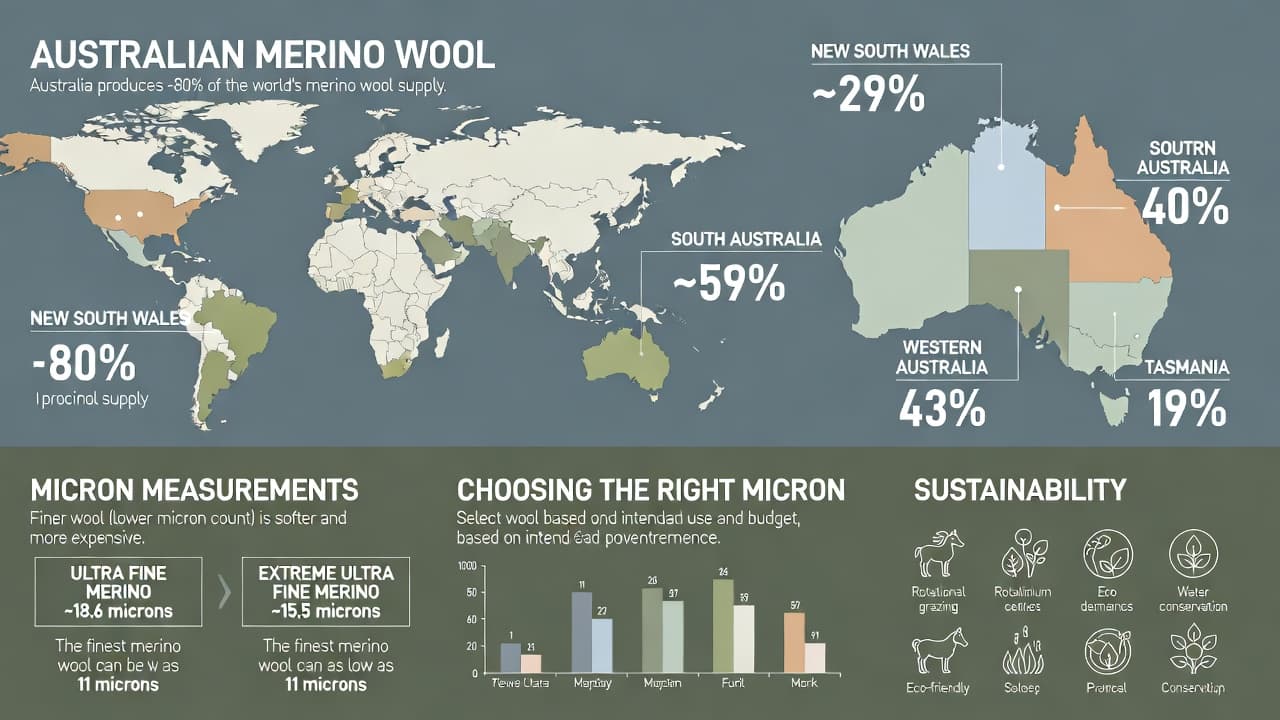

La laine Merino est classée par micron — le diamètre de la fibre en micromètres (µm). Plus le micron est bas, plus la laine est fine et douce. Le Merino à 18 µm ou moins est classé ultrafin ; le Merino au micron le plus bas peut être d'environ 11 µm, souvent appelé extrême ultrafin. Ultrafin et extrême ultrafin sont très doux et soyeux, mais plus chers et plus délicats ; le Merino à micron plus élevé (ex. au-dessus de 20 µm) est plus grossier, plus durable et plus pratique pour un usage quotidien ou intensif.
Ce guide explique quel est le Merino au micron le plus bas, comment le micron affecte la qualité, et comment choisir selon l'usage et le budget.
Le micron (µm) est le diamètre moyen de la fibre de laine. Il affecte directement la douceur, les démangeaisons et les performances : micron plus bas = plus fin et plus doux ; micron plus élevé = plus grossier et plus résistant. Le Merino est l'une des laines de mouton les plus fines, donc souvent étiqueté par micron pour qualité et prix.
Le Merino au micron le plus bas est d'environ 11 µm, commercialisé comme Merino extrême ultrafin. En pratique :
Le minimum que vous verrez se situe donc autour de ~11 µm (extrême ultrafin) ; 18 µm ou moins est la bande standard ultrafine.
| Plage de microns | Classification | Usage typique |
|---|---|---|
| ~11 µm | Extrême ultrafin | Sous-vêtements de luxe, tricot haut de gamme |
| ≤18 µm | Ultrafin | Vêtements doux, activewear, contre la peau |
| ~19–20 µm | Fin | Pulls quotidiens, polyvalent |
| >20 µm | Moyen / plus grossier | Pulls épais, couvertures, usage durable |
Les marques peuvent utiliser des gradations ou étiquettes différentes ; vérifiez les descriptions produit et les avis pour le micron réel ou les allégations « ultrafin ».
Le Merino au micron le plus bas est d'environ 11 µm (extrême ultrafin) ; 18 µm ou moins est ultrafin — très doux et premium. Micron plus bas signifie plus doux et plus luxueux, mais plus cher et plus délicat ; micron plus élevé est plus grossier, plus durable et mieux pour un usage quotidien ou intensif. Choisissez selon l'usage prévu, le confort et le budget.
Le micron est le diamètre de la fibre en micromètres. Plus bas = plus fin et plus doux ; plus élevé = plus grossier et plus résistant.
Oui. 18 µm est dans la plage ultrafine — très doux et adapté contre la peau et aux vêtements de qualité.
La laine ultrafine provient de moutons Merino sélectionnés et de volumes de tonte plus petits ; le traitement et le contrôle qualité sont supérieurs, donc le prix est plus élevé que le Merino standard.
Cet article fait partie de notre série de connaissances sur les fils, offrant des informations pratiques sur les grades de laine Merino et les microns pour tricoteurs et vêtements outdoor.