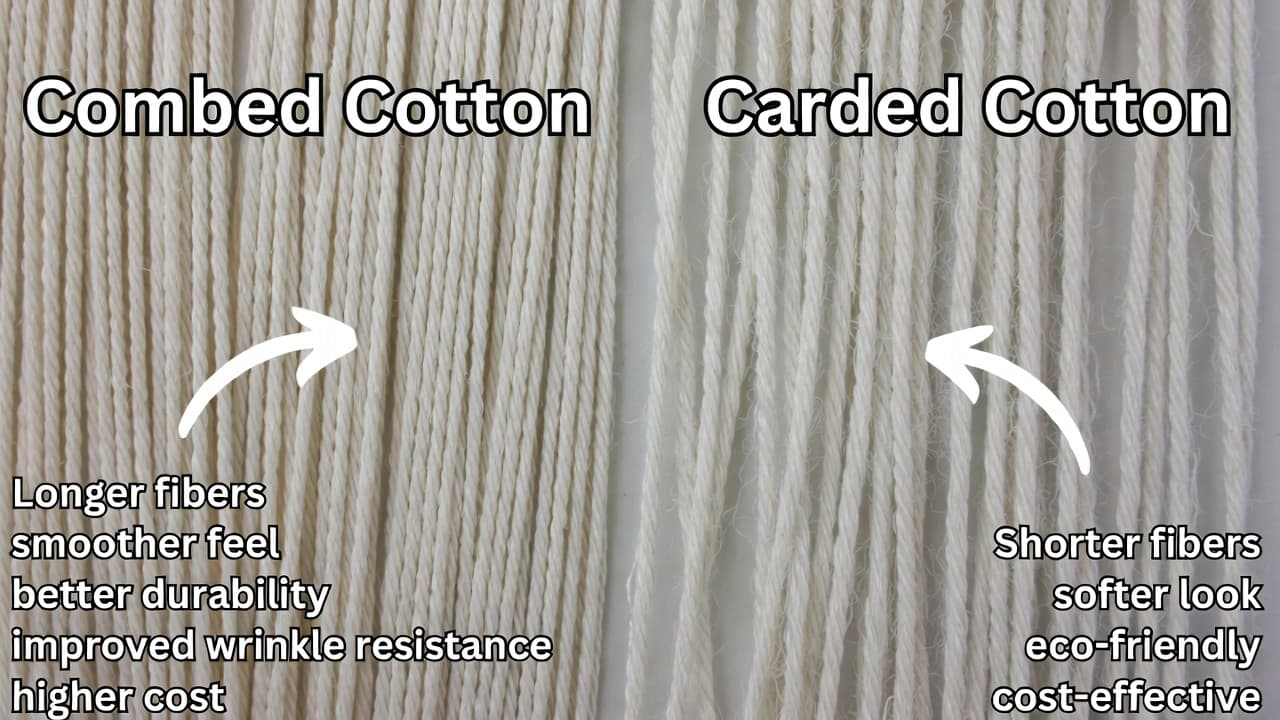

Le coton peigné et le coton cardé sont des méthodes de traitement différentes qui produisent des fils avec une longueur de fibre, une résistance, une finesse et un coût distincts. Le coton peigné est de meilleure qualité et plus cher ; le coton cardé est plus simple et plus abordable.
Dans ce guide, nous expliquons comment distinguer coton peigné et cardé et quand utiliser chacun.
Le coton peigné est obtenu en peignant à répétition le coton brut pour éliminer les fibres plus courtes et fines et conserver les fibres plus longues et fines. Le résultat est un fil plus long, plus résistant et plus fin, adapté aux textiles haut de gamme.
Le coton cardé utilise un traitement plus simple — un seul cardage pour mélanger des fibres de longueur et d'épaisseur similaires, puis étirage et humidification avant filage. Le processus est plus rapide et moins cher, mais le fil est de qualité inférieure au peigné.
| Aspect | Coton peigné | Coton cardé |
|---|---|---|
| Longueur de fibre | Plus longue | Plus courte |
| Résistance de fibre | Plus élevée | Plus faible |
| Finesse de fibre | Plus fine | Plus grossière |
| Traitement | Peignage répété | Un seul cardage |
| Coût | Plus élevé | Plus bas |
| Qualité | Supérieure | Inférieure |
| Idéal pour | Textiles haut de gamme | Usage général |
Le coton peigné offre des fibres plus longues, une résistance plus élevée et une qualité plus fine pour les textiles haut de gamme. Le coton cardé offre un traitement plus simple et un coût plus bas pour l'usage général. Choisissez selon les exigences de qualité et le budget.
Le coton peigné est généralement plus lisse, plus fin et plus résistant. Le cardé peut paraître plus grossier et moins uniforme. Les étiquettes ou les informations du fournisseur peuvent confirmer le type.
Pour la qualité et la durabilité, oui. Pour le coût et l'usage général, le cardé peut suffire.
Le coton peigné sert aux chemises haut de gamme, maille fine, literie premium et autres textiles de qualité.
Il nécessite plus de traitement (peignage répété) pour éliminer les fibres courtes, ce qui augmente le coût de production.
Cet article fait partie de notre série connaissances textiles, avec des conseils pratiques sur le traitement du coton, la qualité et le choix pour fabricants et artisans.