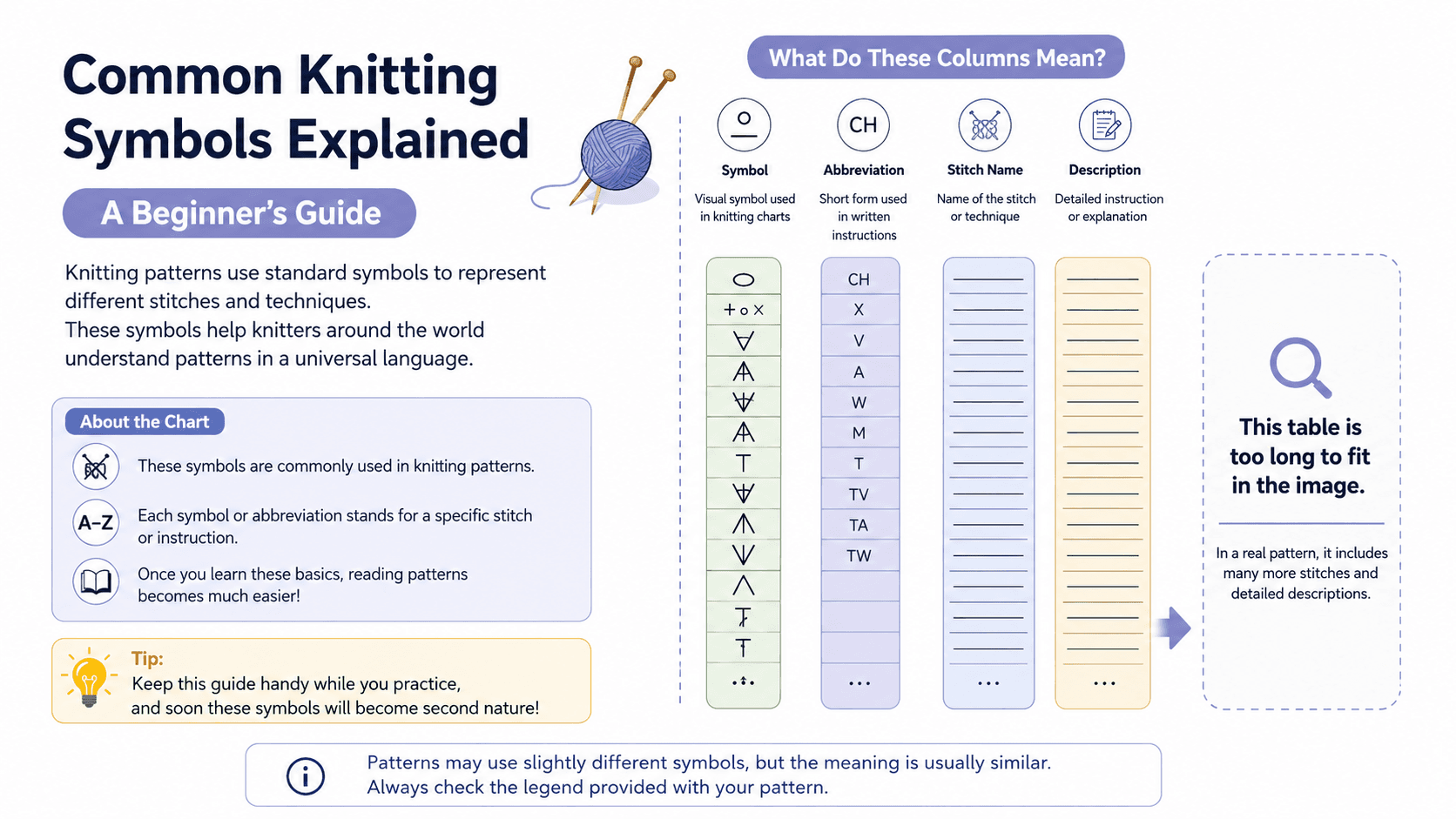

Letter-based crochet charts use short codes—CH, X, T, F, E, and others—instead of the pictographic symbols published by the Craft Yarn Council (CYC). The stitches are the same ones you already know; only the notation changes. X means single crochet (US), T means half double crochet, F means double crochet, and E means treble crochet.
This guide explains what each code stands for, how increases and decreases are named, and how to map letter charts to US and UK terminology—so you can read international patterns and diagram keys with confidence.
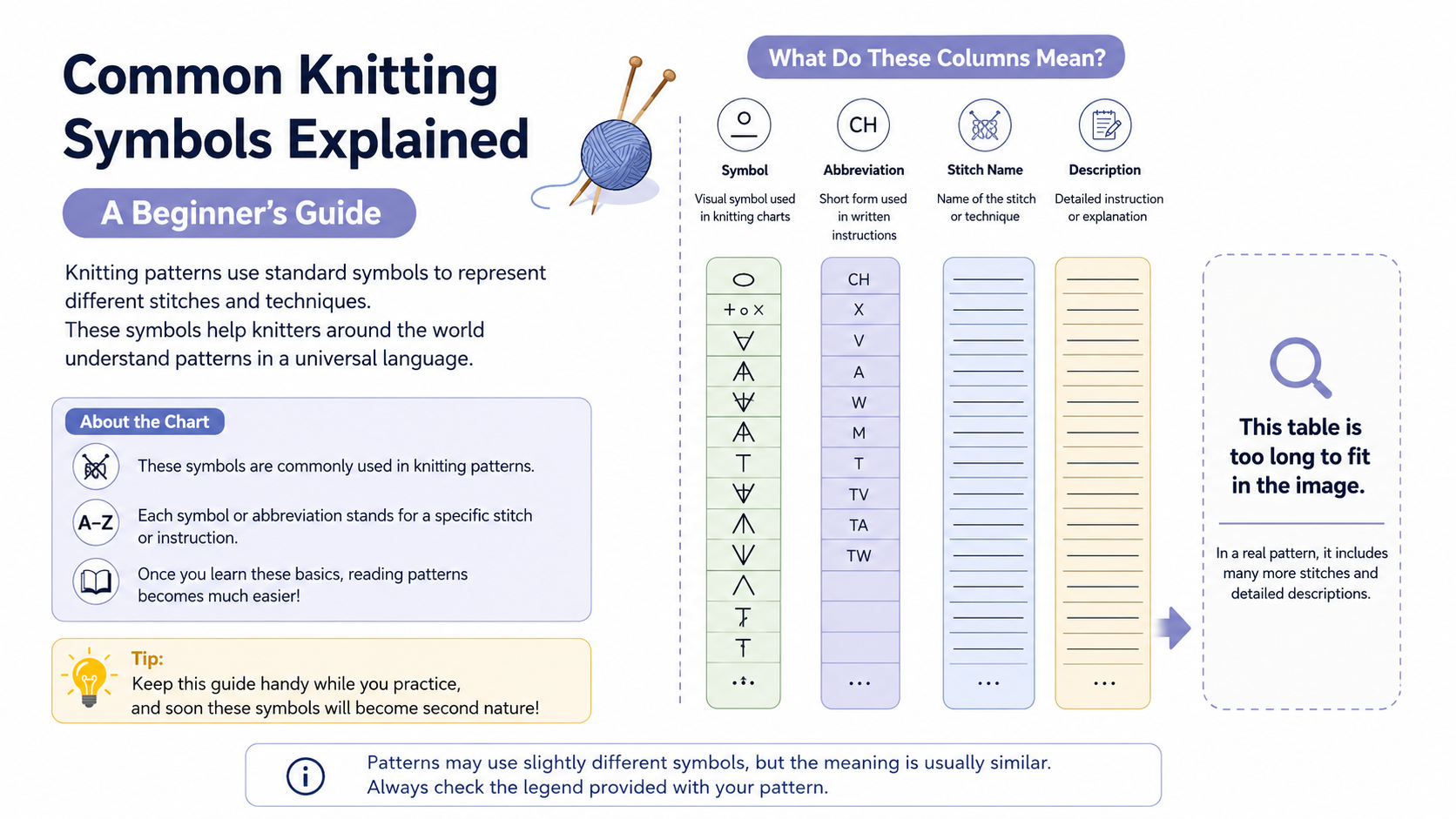
Crochet patterns can show stitches in three common ways:
| Method | What you see | Common in |
|---|---|---|
| Written instructions | "sc in next st, ch 1, turn" | US/UK books, Ravelry |
| CYC diagram symbols | Standardized icons (T-shape, bars, ovals) | Western magazines, yarn labels |
| Letter codes on charts | X, T, F, E, V, A on grid diagrams | Social tutorials, East Asian craft books, exported PDF patterns |
Letter charts are not a different stitch system. They are a shorthand legend printed beside (or on) a diagram. Once you learn the code set, you can follow the same amigurumi, blanket, or garment shapes you would from any other chart.
Each reference table below includes:
| Column | Meaning |
|---|---|
| Code | Letter(s) printed on the pattern |
| Diagram shape | What the icon usually looks like on the chart |
| US term | American crochet name |
| UK term | British name (when it differs) |
| How to work it | One-line instruction |
Important: In this letter system, X = single crochet (US) and T = half double crochet (US). That is not the same as every Western chart key—always read the pattern legend if the designer provides one.
These four letters describe stitch height from shortest to tallest (after chain and slip stitch):
| Code | US term | UK term | Hook motion (simplified) |
|---|---|---|---|
| X | Single crochet (sc) | Double crochet (dc) | Insert hook → yarn over → pull up loop → yarn over → pull through 2 loops |
| T | Half double crochet (hdc) | Half treble (htr) | Yarn over → insert → pull up loop → yarn over → pull through all 3 loops |
| F | Double crochet (dc) | Treble (tr) | Yarn over → insert → pull up loop → (yarn over, pull through 2 loops) × 2 |
| E | Treble crochet (tr) | Double treble (dtr) | Yarn over twice → insert → pull up loop → (yarn over, pull through 2 loops) × 3 |
Memory tip: More horizontal bars on the diagram (or taller letter family) = taller stitch = more yarn used per row.
| Code | Diagram shape | US term | UK term | How to work it |
|---|---|---|---|---|
| CH | Oval / chain link | Chain (ch) | Chain (ch) | Pull a new loop through the loop on the hook to build a foundation row or gap |
| SL | Filled dot / small oval | Slip stitch (sl st) | Slip stitch (ss) | Insert hook, yarn over, pull through stitch and loop on hook in one motion—joins rounds or finishes edges |
| K | (text only) | Skip stitch (sk) | Miss (miss) | Skip the next stitch without working into it |
All stitches in this group are single crochet height unless the pattern adds BLO/FLO (see below).
| Code | Diagram shape | US term | UK term | How to work it |
|---|---|---|---|---|
| X | Cross (+) or × | Single crochet (sc) | Double crochet (dc) | One sc in the indicated stitch |
| V | X with V-shaped base | SC increase | DC increase | 2 sc in the same stitch |
| A | X with inverted V base | SC decrease (sc2tog) | DC decrease | 2 sc worked together over 2 stitches |
| W | X with W-shaped base | 3 sc in one st | 3 dc in one st | 3 sc in the same stitch |
| M | X with inverted W base | 3 sc together | 3 dc together | 3 sc worked together over 3 stitches |
| Code | Diagram shape | US term | UK term | How to work it |
|---|---|---|---|---|
| T | T-shape | Half double crochet (hdc) | Half treble (htr) | Standard hdc in the stitch |
| TV | T + V base | HDC increase | HTR increase | 2 hdc in the same stitch |
| TA | T + inverted V | HDC decrease (hdc2tog) | HTR decrease | 2 hdc together |
| TW | T + W base | 3 hdc in one st | 3 htr in one st | 3 hdc in the same stitch |
| TM | T + inverted W | 3 hdc together | 3 htr together | 3 hdc worked together |
| Code | Diagram shape | US term | UK term | How to work it |
|---|---|---|---|---|
| F | T with one horizontal bar | Double crochet (dc) | Treble (tr) | Standard dc in the stitch |
| FV | F + V base | DC increase | TR increase | 2 dc in the same stitch |
| FA | F + inverted V | DC decrease (dc2tog) | TR decrease | 2 dc together |
| FW | F + W base | 3 dc in one st | 3 tr in one st | 3 dc in the same stitch |
| FM | F + inverted W | 3 dc together | 3 tr together | 3 dc worked together |
| Code | Diagram shape | US term | UK term | How to work it |
|---|---|---|---|---|
| E | T with two horizontal bars | Treble crochet (tr) | Double treble (dtr) | Standard treble in the stitch |
| EV | E + V base | TR increase | DTR increase | 2 treble in the same stitch |
| EA | E + inverted V | TR decrease (tr2tog) | DTR decrease | 2 treble together |
| EW | E + W base | 3 tr in one st | 3 dtr in one st | 3 treble in the same stitch |
| EM | E + inverted W | 3 tr together | 3 dtr together | 3 treble worked together |
Letter charts use a consistent suffix pattern:
| Suffix | Meaning | Example |
|---|---|---|
| V | Increase by 1 (2 stitches in 1 place) | XV = 2 sc; FV = 2 dc |
| A | Decrease by 1 (2 stitches → 1) | XA = sc2tog; FA = dc2tog |
| W | Increase by 2 (3 stitches in 1 place) | XW = 3 sc in one st |
| M | Decrease by 2 (3 stitches → 1) | XM = 3 sc together |
The first letter tells you stitch height; the suffix tells you shape (plain, increase, or decrease).
| Code | Diagram shape | US / UK term | Effect |
|---|---|---|---|
| BLO | Arc opening upward (⌒) | Back loop only | Work into the loop farther from you—creates ribbing or a fold line |
| FLO | Arc opening downward (⌓) | Front loop only | Work into the loop closer to you—creates a raised ridge |
These modifiers combine with any base stitch—for example, X BLO means single crochet in the back loop only. Common in hats, cuffs, amigurumi, and basket-style texture.
| Code | Diagram shape | US term | UK term | How to work it |
|---|---|---|---|---|
| G | Globe / cluster | Popcorn stitch | Popcorn stitch | Ch 3, work 5 dc in same st, remove hook, insert from front into first dc, pull loop through, ch 1 to secure |
| Q | Striped oval | Puff stitch | Puff stitch | Work 3 incomplete hdc (leave last loop on hook each time), yarn over, pull through all loops |
British patterns use different names for the same stitch heights. Use this table when a pattern lists UK terms:
| US term | UK term | Letter code in this system |
|---|---|---|
| Single crochet (sc) | Double crochet (dc) | X |
| Half double crochet (hdc) | Half treble (htr) | T |
| Double crochet (dc) | Treble (tr) | F |
| Treble crochet (tr) | Double treble (dtr) | E |
| Feature | Letter chart (X, T, F, E) | CYC pictographic chart |
|---|---|---|
| Notation | Letters beside grid cells | Standardized icons |
| Learning curve | Fast if you memorize ~10 codes | Fast if you know international symbols |
| Stitches described | Same US/UK stitches | Same US/UK stitches |
| Legend required? | Yes—confirm X = sc in your pattern | Yes—designer variations exist |
Both systems describe standard crochet stitches. Pick the legend your pattern provides; use this guide when the legend matches the X / T / F / E family.
X stands for single crochet (US) or double crochet (UK)—the shortest basic stitch worked into a previous row, after chain and slip stitch.
F is double crochet: one yarn-over before you insert the hook. E is treble crochet: two yarn-overs before insert—taller, with more vertical coverage per stitch.
V marks an increase: two stitches of the same type in one place. The base letter sets the height—TV is two half double crochets; FV is two double crochets.
BLO (back loop only) and FLO (front loop only) change texture and structure—ribbing, folds, and raised lines—without changing stitch height.
No. CYC charts use pictographic icons regulated for Western publications. Letter charts use alphabetic codes common in diagram-heavy patterns shared online and in some international craft books. The stitches are the same; only the key differs.
Use it when the pattern legend matches X = sc, T = hdc, F = dc, E = tr. If the legend defines codes differently, follow the designer’s key—not this generic reference.
Letter-based crochet charts compress stitch instructions into memorable codes: CH for chain, X/T/F/E for the four main heights, V/A/W/M for shaping, and BLO/FLO for loop placement. Map each code to the US or UK name your pattern uses, check the legend once, and the diagram grid becomes straightforward to follow.
Part of our Crochet Basics series—clear, practical guides for crocheters, designers, and yarn buyers working with international patterns and suppliers.