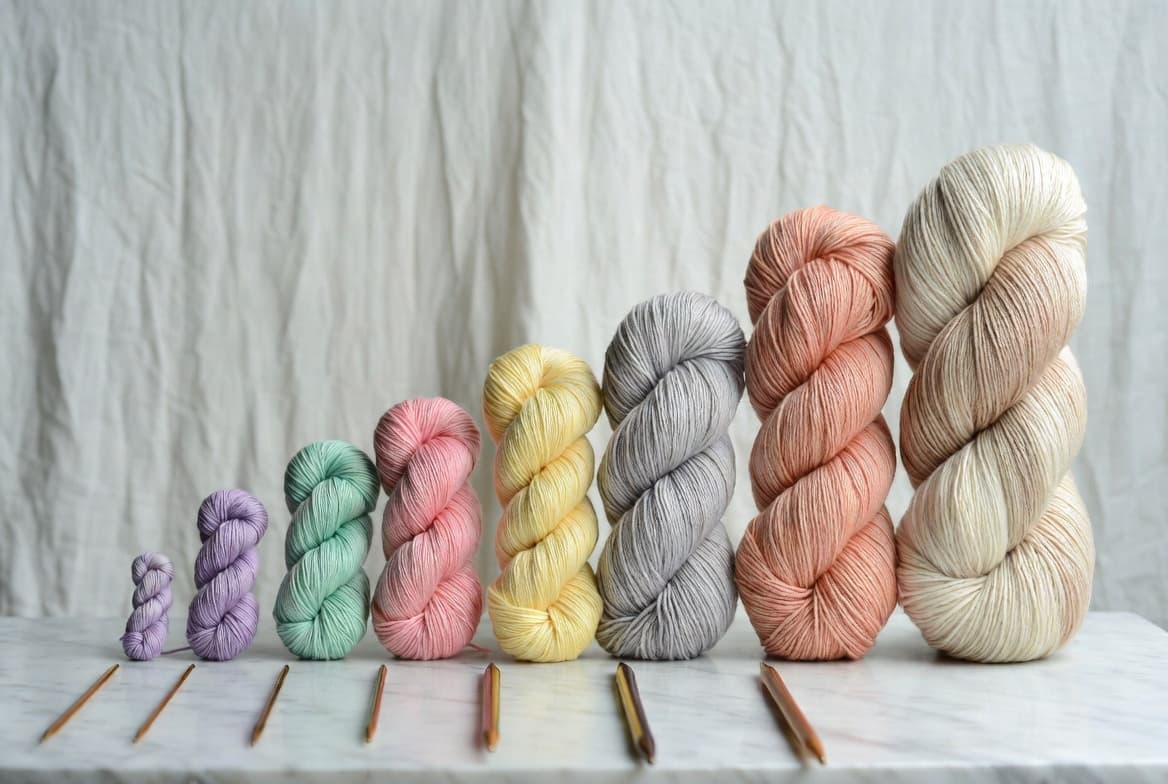

Yarn weight means thickness, not scale weight in grams. It drives gauge (stitches per 10 cm), yardage per ball, and which products a SKU fits. Buyers use US CYC categories (#0–#7), UK ply names, and factory Nm count—three systems for the same physical property.
This guide gives you one chart to convert between them and spec yarn correctly on purchase orders and RFQs.
| Term | Meaning |
|---|---|
| Yarn weight / thickness | How thick the strand is—lace to jumbo |
| Gauge | Stitches and rows per 10 cm at a stated needle/hook size |
| Nm (metric count) | Meters of yarn per gram × 1,000—higher Nm = finer yarn |
| WPI | Wraps per inch around a ruler—quick hand comparison |
| Ball weight | Grams per ball or cone—separate from "yarn weight category" |
A 100 g ball of worsted yarn contains less length than 100 g of fingering because the strand is thicker.
| Category | Name | Hook (mm) | Needle (mm) | Gauge (sts / 10 cm)* | WPI† |
|---|---|---|---|---|---|
| #0 | Lace | 1.4–2.25 | 1.5–2.25 | 32–42 | 18+ |
| #1 | Super Fine / Fingering | 2.25–3.5 | 2.25–3.25 | 27–32 | 14–18 |
| #2 | Fine / Sport | 3.25–3.75 | 3.25–3.75 | 23–26 | 12–14 |
| #3 | Light / DK | 3.75–4.5 | 3.75–4.5 | 21–24 | 11–12 |
| #4 | Medium / Worsted | 4.5–5.5 | 4.5–5.5 | 16–20 | 9–11 |
| #5 | Bulky / Chunky | 5.5–8 | 5.5–8 | 12–15 | 6–8 |
| #6 | Super Bulky | 8–12 | 8–12 | 7–11 | 5–6 |
| #7 | Jumbo | 12+ | 12+ | 0–6 | 1–4 |
*Typical stockinette or single crochet range; pattern-specific.
†WPI = wraps per inch (approximate).
Most craft retail volume sits in #4 worsted and #5 bulky acrylic.
| UK term | US equivalent | Important note |
|---|---|---|
| 2-ply | Lace / fingering | Fine yarn |
| 4-ply | Sport / fingering | Not US "#4 medium" |
| DK | #3 Light | "Double knitting" |
| Aran | #4–#5 | Slightly heavier than worsted |
| Chunky | #5 Bulky | |
| Super chunky | #6 Super bulky |
UK "4-ply" ≠ US "4 weight." Always confirm gauge and Nm, not name alone.
Nm = metric count (meters per gram × 1,000). Higher number = finer yarn.
| Approx. Nm | US category | Typical use |
|---|---|---|
| Nm 10–20 | Lace / fingering | Shawls, fine gauge |
| Nm 5–10 | Sport / DK | Garments |
| Nm 2–5 | Worsted / aran | Sweaters, blankets |
| Nm 0.5–2 | Bulky / super bulky | Quick blankets, chenille-style |
Two yarns at the same Nm can feel different if fiber or twist differs—request a knit-down swatch when comparing quotes.
| Factory says | Likely US category |
|---|---|
| Nm 1.8 | Bulky / chunky (#5) |
| Nm 2.5 | Worsted (#4) |
| Nm 5.0 | DK (#3) |
| "8/2 cotton" (indirect count) | Fine thread—verify WPI and gauge |
| US weight | Common ball size | Approx. length per 100 g |
|---|---|---|
| Fingering | 50–100 g | 400–480 m |
| DK | 50–100 g | 200–250 m |
| Worsted | 100 g | 180–220 m |
| Bulky | 100–200 g | 100–150 m |
| Super bulky | 200–300 g | 60–100 m |
Use for costing and yardage estimates. Always confirm actual put-up on the factory spec sheet.
| Retail / wholesale product | Typical weight |
|---|---|
| Amigurumi and small kits | DK–worsted (#3–#4) |
| Value afghan blankets | Worsted–bulky (#4–#5) |
| Premium throws | Bulky chenille (#5–#6) |
| Socks | Fingering–DK (#1–#3) |
| Marketplace gradient cakes | DK–worsted |
| Craft chain bestsellers | Worsted acrylic (#4) |
Include all five lines—reduces factory misunderstanding and inspection disputes:
| # | PO line item |
|---|---|
| 1 | CYC category (e.g. #4 Medium / worsted) |
| 2 | Nm count (e.g. Nm 2.0) |
| 3 | Target gauge (e.g. 18 sts × 24 rows / 10 cm stockinette) |
| 4 | Recommended needle/hook size for consumer label |
| 5 | Ball weight and yardage tolerance (e.g. 100 g ±3%, 200 m minimum) |
Worsted (#4) and bulky (#5) acrylic account for the largest share of mass-market knitting and crochet SKUs.
They are not interchangeable without gauge adjustment. DK is thinner; substituting DK for worsted usually requires larger needle/hook or more yardage—often 20–30% more length for the same dimensions.
Roughly bulky / chunky (#5)—common for blanket yarn and chenille-type products.
WPI helps compare samples, but elastic fibers (wool, acrylic) vary. Combine WPI with factory gauge data and a signed swatch.
Yes. Bulkier yarns use more fiber per meter; fine counts may have higher spinning cost. Weight category affects container packing density and freight cost per unit.
Close but not identical. Aran is often slightly heavier than US worsted. Spec gauge and Nm, not trade name only.
Yarn weight is thickness—expressed as US #0–#7, UK ply, or Nm depending on who you talk to. For B2B sourcing, put CYC category + Nm + target gauge + ball put-up on every PO. When systems disagree, trust measured gauge over label names.
Print or share this chart in RFQs, supplier meetings, and tech packs so product, sourcing, and factory teams use the same language.
Need yarn at a specific weight and Nm? Explore our yarn range or request a quote with your target gauge and ball size.